You Won’t Believe How Zermatt’s Terrain Changes Everything
Zermatt isn’t just another pretty mountain town—it’s a gateway to one of the most unique landscapes on Earth. Nestled in the Swiss Alps, its dramatic terrain shapes every part of the experience, from how you move around to what you feel standing beneath the Matterhorn. I’ve been to alpine spots before, but nothing prepared me for this. The way the land rises, shifts, and surprises at every turn makes Zermatt more than a destination—it becomes a journey into nature’s raw power and beauty.
The First Glimpse: Arrival in a Car-Free Wonderland
Approaching Zermatt by train, the world seems to slow down. As the railway car glides through the narrow valley, the first glimpse of wooden chalets nestled between forested slopes appears almost dreamlike. There are no engines idling, no exhaust fumes—only the soft chime of cowbells and the distant rush of glacial streams. This is one of the last car-free towns in the Alps, and the absence of motor vehicles transforms the atmosphere immediately. Visitors step off the train and into a realm where silence is not just possible but profound. The air feels cleaner, sharper, carrying the scent of pine and fresh snow even in summer.
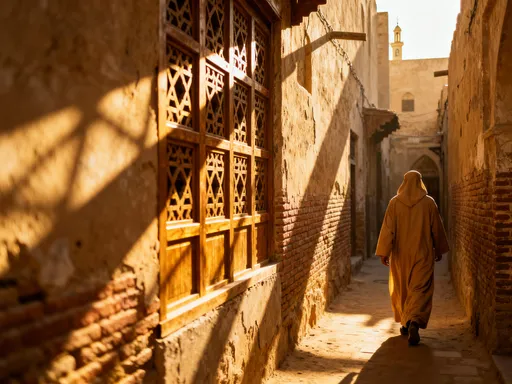
The town’s layout reflects centuries of adaptation to its rugged surroundings. Streets are narrow, cobbled, and often winding, designed not for convenience but for survival in a landscape that defies flat horizons. Buildings cluster together for warmth and protection, their steeply pitched roofs engineered to shed heavy snowfall. Horse-drawn carriages move quietly along designated paths, serving both as transport and as a nod to tradition. Electric taxis and small utility vehicles, permitted only for essential services, glide soundlessly through side lanes, preserving the tranquility that defines Zermatt’s character.
This car-free policy is not merely a tourist attraction—it is a public health and environmental decision with measurable benefits. Studies have shown that towns with restricted vehicle access report lower levels of respiratory issues and improved mental well-being among residents and guests alike. The air quality in Zermatt consistently ranks among the best in Europe, a fact often cited by visitors who notice deeper breathing and increased energy within hours of arrival. For families, especially those with young children or elderly members, this makes the destination not only scenic but inherently restorative.
What stands out most is how seamlessly human life integrates with the constraints of the terrain. There is no attempt to conquer the mountain; instead, there is a quiet respect for its dominance. Every path, every structure, every mode of movement acknowledges the slope, the snow load, the wind patterns. This harmony between people and place begins the moment one steps off the train, setting the tone for an experience that is as much about inner peace as it is about alpine adventure.
Matterhorn’s Shadow: How One Peak Defines an Entire Region
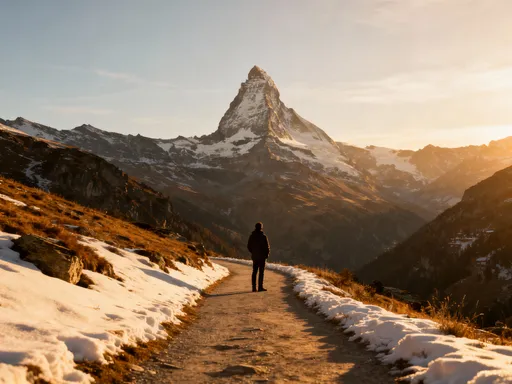
The Matterhorn looms over Zermatt like a sentinel, its iconic pyramid shape rising abruptly from the surrounding peaks. At 4,478 meters, it is not the tallest mountain in the Alps, but it is undoubtedly the most recognizable. Its near-symmetrical form, forged by millennia of glacial erosion, is a geological rarity. Most alpine peaks are shaped by multiple fault lines and weathering patterns, resulting in jagged ridges or broad domes. The Matterhorn, however, stands apart—its four faces carved by glaciers moving in precise directions, creating a near-perfect pyramid that appears to pierce the sky.
This unique formation does more than inspire postcards; it influences the entire microclimate of the region. The mountain acts as a barrier to weather systems, causing clouds to gather on its southern flank while the northern side enjoys sudden bursts of sunshine. This creates unpredictable visibility—on some mornings, the summit is shrouded in mist, while by afternoon, it emerges in full glory, bathed in golden light. Locals often refer to this as the “Matterhorn smile,” a phenomenon that draws photographers and pilgrims alike to vantage points such as Sunnega and Kirchbrücke, where the peak reveals itself in dramatic fashion.
Culturally, the Matterhorn is more than a landmark—it is a symbol of resilience and aspiration. Its first successful ascent in 1865 ended in tragedy, with four climbers losing their lives during the descent, yet that event cemented its legend. Today, the mountain continues to draw experienced mountaineers, though only a fraction attempt the summit. Most visitors content themselves with viewing platforms and guided walks that offer safe but breathtaking perspectives. The presence of the peak shapes everything from local art to cuisine, with motifs appearing on everything from hand-carved souvenirs to hotel linens.
Tourism in Zermatt is intrinsically tied to the Matterhorn’s image. Over 1.5 million visitors arrive annually, many specifically to see or photograph the peak. Yet the town has managed to avoid over-commercialization by enforcing strict building codes and limiting infrastructure expansion. This balance ensures that the mountain remains the focal point, not overshadowed by human development. In this way, the terrain—embodied by the Matterhorn—dictates not just the physical layout of the region but also its cultural identity and economic model.
Vertical Living: How Locals Adapt to Extreme Terrain
Life in Zermatt is lived on an incline. Homes, shops, and even schools are built into steep slopes, their foundations anchored deep into bedrock to withstand the forces of gravity and snow pressure. Construction here follows engineering principles distinct from those in flatland towns. Walls are thicker, supports are reinforced, and roofs are designed at sharp angles to prevent snow accumulation. Many buildings incorporate traditional materials like larch wood and stone, which not only blend with the natural surroundings but also provide superior insulation against freezing temperatures.
Seasonal challenges define daily routines. Winter brings heavy snowfall—sometimes over three meters in a single season—requiring constant clearing and careful structural planning. Avalanches are a real risk, particularly on the upper slopes, so early warning systems and controlled detonations are part of municipal operations. Residents are trained in emergency protocols, and many homes have reinforced basements designated as safety zones. Despite these dangers, the community maintains a calm preparedness, passed down through generations who understand that living in harmony with the mountain means respecting its power.
Supply logistics present another layer of complexity. With limited road access and no through traffic, goods must be transported by rail and then moved via electric carts or sleds. Grocery deliveries happen on fixed schedules, and bulk purchases are common during accessible months. Some families use underground storage rooms cooled naturally by mountain air, reducing reliance on electricity. Heated roofs, now standard in new constructions, prevent ice dams and icicle formation, enhancing safety during thaw periods.
Innovations in infrastructure reflect both necessity and foresight. Underground utility tunnels protect water and power lines from freezing, while solar panels on south-facing roofs maximize energy capture during short winter days. Rainwater is collected and filtered for non-potable uses, conserving resources in a region where every drop counts. These adaptations are not luxury upgrades—they are essential strategies for survival in a vertical world where nature sets the rules and humans must listen carefully.
Movement Without Roads: The Genius of Zermatt’s Transport Web
Getting around Zermatt is an exercise in thoughtful design. Without cars, the town relies on a layered transport system that prioritizes efficiency, safety, and environmental stewardship. At ground level, electric shuttles—quiet, compact, and emission-free—move visitors and residents between key points. These vehicles follow fixed routes but can be hailed like taxis, offering flexibility without noise pollution. For a more traditional experience, horse-drawn carriages operate in the central district, particularly popular with families and photographers seeking a nostalgic touch.
For longer distances and elevation gains, the network shifts to rail and cable transport. The Gornergrat Bahn, a cogwheel train that has been operating since 1898, climbs from Zermatt to over 3,000 meters, offering panoramic views along the way. This electric railway is powered by renewable hydroelectric sources, aligning with the town’s commitment to sustainability. Cable cars and gondolas provide access to high-altitude hiking and skiing areas, with stations strategically placed to minimize walking distance on icy or uneven terrain.
E-bikes have become increasingly popular, especially during summer months. Rental stations are scattered throughout town, and dedicated bike paths—graded for safety and surfaced with non-slip materials—connect major attractions. These bikes assist riders on steep climbs, making exploration accessible to a wider range of ages and fitness levels. Signage is clear and multilingual, with color-coded trails indicating difficulty levels, ensuring that even first-time visitors can navigate confidently.
The entire system is designed with terrain in mind. Routes avoid the steepest gradients where possible, and transitions between modes of transport are seamless. A visitor might take a shuttle to the train station, ride the Gornergrat Bahn to a high alpine plateau, then hike to a mountain hut—all without encountering a single traffic light or exhaust fumes. This integration of transport options sets a benchmark for sustainable tourism, proving that convenience and environmental care can coexist when planning respects the natural landscape.
Trailtopia: Hiking Routes That Defy Expectation
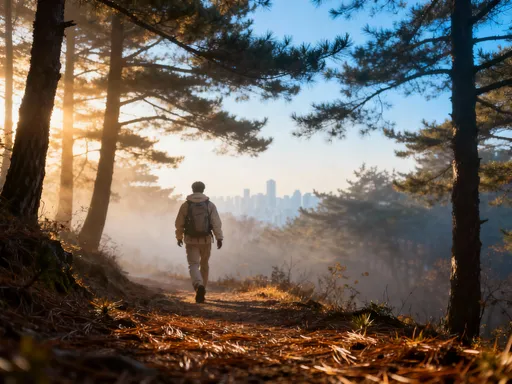
Hiking in Zermatt is not just about walking—it’s about discovery. The terrain ensures that every trail offers something unexpected, whether it’s a sudden view of the Matterhorn reflected in a glacial lake or a shift from sun-drenched meadow to shaded pine forest within minutes. One of the most celebrated routes is the Five Lakes Walk, a moderate loop that takes hikers past five pristine alpine lakes, each offering a different vantage point of the Matterhorn. The trail is well-maintained, with wooden bridges over streams and stone steps on steep sections, making it suitable for families and older adults.
What makes this and other trails remarkable is how elevation shapes the experience. Over just a few kilometers, hikers may ascend 400 meters, moving through distinct ecological zones. At lower altitudes, wildflowers bloom in abundance—edelweiss, gentians, and alpine roses painting the slopes in vibrant hues. Higher up, the vegetation thins, giving way to rocky outcrops and snowfields that persist into summer. The air grows thinner, encouraging slower pacing and deeper appreciation of surroundings.
Trail design in Zermatt reflects both safety and immersion. Paths are graded according to difficulty, with clear signage indicating estimated duration, elevation gain, and terrain type. Safety rails and barriers are installed on exposed sections, particularly near cliffs or unstable ground. Information boards at trailheads provide weather forecasts and wildlife tips, while emergency call boxes are spaced at regular intervals. Rangers patrol popular routes during peak season, offering assistance and monitoring conditions.
Microclimates add another dimension to the hiking experience. Due to the angle of sun exposure and wind patterns, one side of a valley may be warm and dry while the opposite slope remains cool and misty. Hikers often carry layers to adapt quickly, and guides recommend checking conditions before setting out. These subtle shifts in environment enhance the sense of adventure, reminding visitors that nature here is dynamic and ever-changing. Trails are not just paths—they are invitations to engage with the mountain on its own terms.
Winter’s Playground: Skiing and Snow Reliability in a High-Altitude Arena
When winter arrives, Zermatt transforms into a world-class ski destination, drawing enthusiasts from across the globe. The ski area spans over 360 kilometers of pistes, linked with the Italian resort of Cervinia, creating one of the largest interconnected winter sports regions in the Alps. What sets Zermatt apart is its high-altitude advantage—much of the skiing takes place above 3,000 meters, where temperatures remain low enough to preserve snow even during milder winters. The Theodul Glacier, accessible via cable car, offers year-round skiing, a rare feature that attracts summer training groups and curious tourists alike.
Natural snowfall is abundant, averaging over 6 meters annually, but the resort supplements this with targeted snowmaking on lower slopes and key access routes. Unlike low-altitude resorts that rely heavily on artificial snow, Zermatt uses it sparingly, focusing on efficiency and environmental responsibility. The snowmaking system draws water from high-altitude reservoirs, minimizing impact on local ecosystems, and operates only when temperatures are sufficiently low to ensure optimal snow quality.
Ski routes are thoughtfully designed to accommodate all skill levels. Beginners benefit from sheltered learning zones near the village, where gentle slopes are protected from wind and receive consistent sun. Intermediate skiers enjoy long, winding runs through open bowls and forested glades, with panoramic views at every turn. Experts seek out the challenging couloirs and off-piste areas near the Klein Matterhorn, where terrain shaped by ancient glaciers demands precision and experience. Guides offer daily briefings on avalanche risk and route conditions, ensuring safety without sacrificing adventure.
What truly defines Zermatt’s winter appeal is the consistency of its snow cover. While many alpine resorts face uncertainty due to climate fluctuations, Zermatt’s elevation provides a natural buffer. Studies indicate that high-altitude glaciers in the region are receding more slowly than those at lower elevations, suggesting continued reliability for the foreseeable future. This stability makes Zermatt not just a premier destination but a model for climate-resilient winter tourism.
Why This Terrain Matters: Lessons Beyond Scenery
Zermatt’s landscape teaches more than how to navigate steep paths or dress for alpine weather—it offers a deeper lesson in humility and harmony. The terrain does not bend to human will; instead, it demands adaptation, respect, and long-term thinking. Every aspect of life in Zermatt, from transport to housing to recreation, reflects a commitment to working with nature rather than against it. This mindset has produced a community that is resilient, sustainable, and deeply connected to its environment.
For visitors, the experience goes beyond sightseeing. Walking through the quiet streets, hiking trails with shifting light, or standing beneath the towering Matterhorn, one begins to sense a different rhythm—one that values stillness, clarity, and balance. In a world often defined by speed and consumption, Zermatt stands as a reminder that beauty and well-being can flourish when we align with natural limits rather than trying to override them.
The town’s approach to tourism offers a blueprint for other mountain destinations facing environmental pressures. By limiting vehicle access, investing in renewable energy, and preserving open space, Zermatt demonstrates that economic vitality and ecological care are not mutually exclusive. Its success lies not in resisting change but in guiding it thoughtfully, ensuring that growth does not come at the cost of authenticity.
Ultimately, Zermatt invites us to reconsider what travel is for. Is it merely about checking destinations off a list? Or can it be a transformative encounter with places that challenge and inspire us? The terrain here does more than shape the land—it shapes perspective. To visit Zermatt is to understand that some of the most powerful experiences come not from conquering nature, but from learning to move within it, quietly, attentively, and with gratitude. In that lesson lies its true, enduring value.